



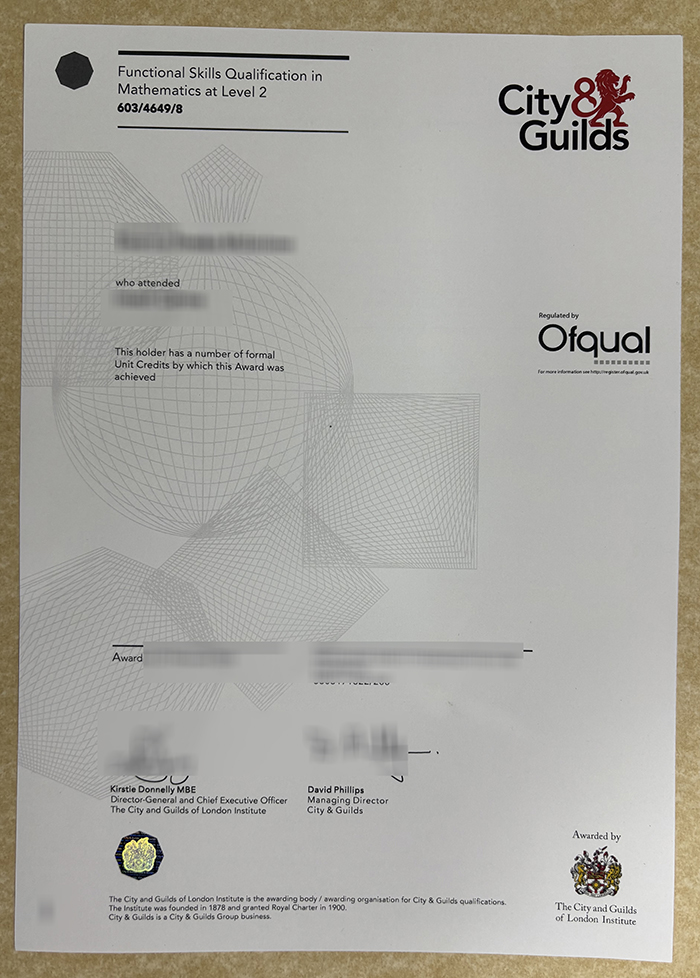
City Guilds FSQ Mathematics at Level 2 Certificate sample 2026, The City & Guilds Functional Skills Qualification (FSQ) Mathematics at Level 2 is a widely recognized advanced foundational mathematics qualification in the UK. Copy City Guilds FSQ Mathematics at Level 2 Certificate. It aims to assess learners’ ability to apply mathematics to solve problems in real-life and work scenarios. In many cases, its effectiveness is considered equivalent to GCSE Mathematics (Grade 4/C), serving as a crucial stepping stone to higher education, apprenticeships, or enhancing workplace competitiveness.
I. Core Objective: Bringing Mathematics Back to Life
Unlike traditional GCSE Mathematics, which emphasizes theory and complex formula derivations, Level 2 FSQ focuses more on practicality. It requires students to apply mathematical tools to real-world situations, such as:
Financial Management: Calculating taxes, interest, budgeting, and currency exchange.
Spatial Layout: Understanding floor plans and calculating areas and volumes for renovation or logistics planning.
Data Analysis: Interpreting charts, calculating averages and probabilities to support business decisions.
II. Exam Structure and Content
City & Guilds’ Level 2 Mathematics exam typically consists of two parts, both required to be completed in a single exam:
Non-Calculator Section: Assesses accuracy in basic arithmetic and logical reasoning.
Calculator Section: Allows the use of a calculator to handle more complex real-world data and multi-step problems.
Content covers three main areas:
Use of Numbers: Fractions, decimals, percentages, proportions, and operations with positive and negative numbers.
Common Measurements, Shapes, and Spaces: Involves perimeter, area, volume, scale drawing, and complex shapes.
Information Processing and Data: Includes drawing statistical charts, calculating means (average, median, mode), and range.
III. Why Choose City & Guilds?
As a long-established awarding body in the UK, City & Guilds’ FSQ certificates have extremely high industry recognition. Its advantages include:
Flexibility: Exams can usually be scheduled on-demand based on the learner’s preparation, and results are released quickly.
Scenario-based questions: Questions are often presented in the form of “workplace challenges” or “life tasks,” making them very friendly to adult learners or non-academic students.
Promotion ladder: For those without GCSE results, it is one of the fastest ways to meet university entry requirements (especially for majors such as nursing and teaching assistantships).